Blog
Kittens are EVIL

“Kittens are EVIL” is a slim volume of published papers and essays from Newcastle University’s original “Little Heresies” speaker series on the future of public services. …. “what appear to be well-intentioned policies not only create perverse incentives but also lasting damage to the social fabric. ” There is a distinct smell of anti-New Public Management rhetoric in the publication and a few of the papers concern only (and require an understanding of) British public policy. But the principle of challenging sacred cows is welcome and that certainly applies to the field of social innovation and social impact. On which subject the www.kittensareevil.org website is a good place to start: “by prefixing ‘social’ to enterprise, investment and innovation we seemingly obviate any need for a critical analysis of whether or not these enterprises, investments and innovations are social, and therefore, presumably, good.” Delicious.
The Little Heresies idea has been taken up by Trinity’s Centre for Social Innovation and you can sign up to be notified of events in our own Little Heresies events series.
Why is a business school researching nonprofits?
People are sometimes surprised to learn that I am based in the Trinity Business School when my research subjects are usually nonprofit organisations (NPOs). In the United States many nonprofit studies happen in a university department which is called something like “Public Administration” and which we would struggle to locate in an Irish university. In Europe it is university business schools that are the home of management studies and of organization studies – that’s the study of how people collectively organize themselves into functioning entities, supported and shaped by cultures, values, norms and legal frameworks. If I was working on some nonprofit discipline such as community development, then I might be part of an Irish sociology school. But as I am interested in nonprofits as organizational entities, here I am in Trinity College Dublin’s Business School.
Do nonprofits therefore sit comfortably in a business school? Well, my experience has been good so far. Business schools often set up specialist research centres and that can include nonprofit studies. University College Cork has the Centre for Co-operative Studies and Oxford has the Skoll Centre for Social Entrepreneurship. Trinity used to have the Centre for Nonprofit Management – but now has the Trinity Centre for Social Innovation where I am located. The premise of the centre is that, while based in the Business School, social innovation should and can have a wider reach across other schools and disciplines, both in the university and in the world of public policy and practice. Social Innovation is about more than “management” and embraces systems change, organizational and entrepreneurial behaviours, pedagogy and much more.
The ethics of academic research
Ethical research is paramount to the validity of my work. Ethics comes in two large packages. The first is the ethics of original work. This manifests itself in finding genuine data – rather than inventing research findings and presenting it as the result of a genuine research programme – and in avoiding plagiarism, that is the appropriation of other people’s work and passing it off as one’s own.
The second big aspect of ethics is the treatment of research subjects. These are the people who are asked to provide information to researchers. Universities provide copious guidance on the ethical treatment of research subjects. I initially found this to be unexpectedly robust and, I eventually realised, intended for practitioners of medical, psychological and other forms of potentially invasive research. STILL AND ALL, I need to apply ethical standards to my research even if the data sought from individuals concern an organisation rather than the person. Specifically,
- your participation in a research study is voluntary.
- I provide information explaining my research, its aims and processes.
- All data obtained in my research is anonymized and personal confidentiality is assured. See below on what this means.
- All data is stored securely using Trinity’s Qualtrics licence. And see below for more re Qualtrics.
- Data is never, ever, shared with or (heaven forbid) sold to third parties.
More about research ethics is available to read here: TCD Business school and research ethics.
What do we mean by anonymized research? In our current study, we will be able to track responses and link them to specific organisations. This is so that we can (a) match you to your organisation’s Benefacts entry and so reduce the amount of data that you provide, (b) follow up respondents and (c) invite a sample to interviews for the final stage of research. HOWEVER, all data is analysed anonymously, i.e. individual respondents or their organisations will not be identified. All results will be published with anonymized data.
The Trinity Business School is able to offer this reassurance by virtue of our research practices and also because we are holding the research data securely on Qualtrics. This is third party research software that is used by business and academia; their security statement is here.
“Social economy” as a label of preference
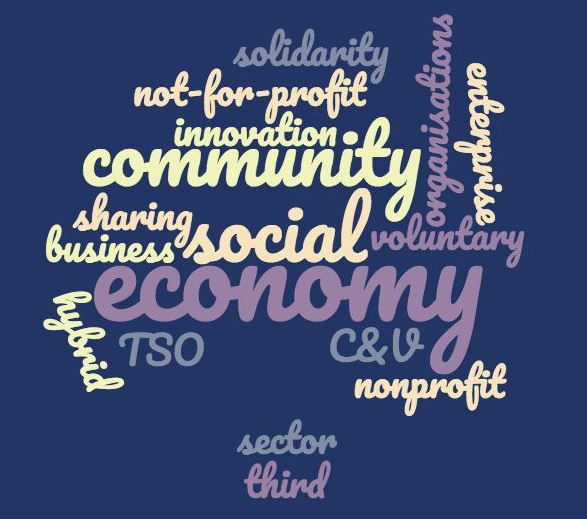
You will have noted that I use the “social economy” to locate my research. There are two reasons. First, I actively like the term social economy – though I admit the definition is fuzzy . And second, I dislike the alternatives, that is the nearly-cognate terms of “nonprofit”, “third sector” and “voluntary sector”.
At its most expansive, “social economy” refers to the sector of organisations whose ownership lies in social capital, rather than in financial capital and investment. And this is how I understand and use the term. However, in the hands of others this definition rapidly narrows down. Some would limit it to economic (i.e. trading) organisations with social (i.e. collective) legal structures: so, mutuals, co-operatives and social enterprises. And at its most narrow I have seen “social economy” used to refer solely to the social enterprise sector or even to individual social enterprises but that may well be just an Irish thing (some of us will remember the Fas Social Economy Programme).
As to the alternatives… My problem with “nonprofit” is that I do not like defining a positive phenomenon in terms of what it is not. Further, any sane organisation needs to generate some form of surplus to remain solvent, cover contingencies and build up a modest development fund, so is “nonprofit” that accurate? A defining difference between non- and for-profits is not a question of surplus but of distribution of surplus. And then there is the argument that “nonprofits” do generate a profit but a social profit rather than a financial profit.
The term “voluntary sector” is hopelessly ambiguous. My understanding was always that “voluntary” means not set up by statute, i.e. that an organisation has been set up by the free choice or volition of its members or activists. However, most of the world has forgotten what voluntary means in this context and thinks it refers to being volunteer-led or that everyone who works there is a volunteer and not paid a wage.
As for “third sector”: I admit to using it, especially in my academic writing. It is (a) comprehensive, (b) less ambiguous than the terms above and (c) generally accepted in academic work. But why should the sector be considered as “third”? It’s too short a step from “third” to “third-rate”. So I use the term but with no enthusiasm.
Finally, “civil society”: I have seen this used as the aggregate of third sector organisations but more generally and more widely, the aggregate of citizens’ collective actions. Wonderful as it is, “civil society” in the latter definition does not fall within my research remit. So, social economy it is. One day, I’ll add “solidarity economy” to this discussion and really mix things up.
 Social Economy Investigator