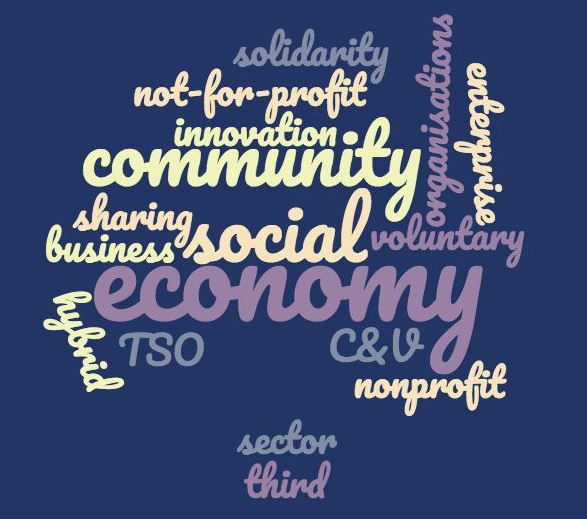
You will have noted that I use the “social economy” to locate my research. There are two reasons. First, I actively like the term social economy – though I admit the definition is fuzzy . And second, I dislike the alternatives, that is the nearly-cognate terms of “nonprofit”, “third sector” and “voluntary sector”.
At its most expansive, “social economy” refers to the sector of organisations whose ownership lies in social capital, rather than in financial capital and investment. And this is how I understand and use the term. However, in the hands of others this definition rapidly narrows down. Some would limit it to economic (i.e. trading) organisations with social (i.e. collective) legal structures: so, mutuals, co-operatives and social enterprises. And at its most narrow I have seen “social economy” used to refer solely to the social enterprise sector or even to individual social enterprises but that may well be just an Irish thing (some of us will remember the Fas Social Economy Programme).
As to the alternatives… My problem with “nonprofit” is that I do not like defining a positive phenomenon in terms of what it is not. Further, any sane organisation needs to generate some form of surplus to remain solvent, cover contingencies and build up a modest development fund, so is “nonprofit” that accurate? A defining difference between non- and for-profits is not a question of surplus but of distribution of surplus. And then there is the argument that “nonprofits” do generate a profit but a social profit rather than a financial profit.
The term “voluntary sector” is hopelessly ambiguous. My understanding was always that “voluntary” means not set up by statute, i.e. that an organisation has been set up by the free choice or volition of its members or activists. However, most of the world has forgotten what voluntary means in this context and thinks it refers to being volunteer-led or that everyone who works there is a volunteer and not paid a wage.
As for “third sector”: I admit to using it, especially in my academic writing. It is (a) comprehensive, (b) less ambiguous than the terms above and (c) generally accepted in academic work. But why should the sector be considered as “third”? It’s too short a step from “third” to “third-rate”. So I use the term but with no enthusiasm.
Finally, “civil society”: I have seen this used as the aggregate of third sector organisations but more generally and more widely, the aggregate of citizens’ collective actions. Wonderful as it is, “civil society” in the latter definition does not fall within my research remit. So, social economy it is. One day, I’ll add “solidarity economy” to this discussion and really mix things up.
 Social Economy Investigator
Leave a comment